
Introduction: India in England
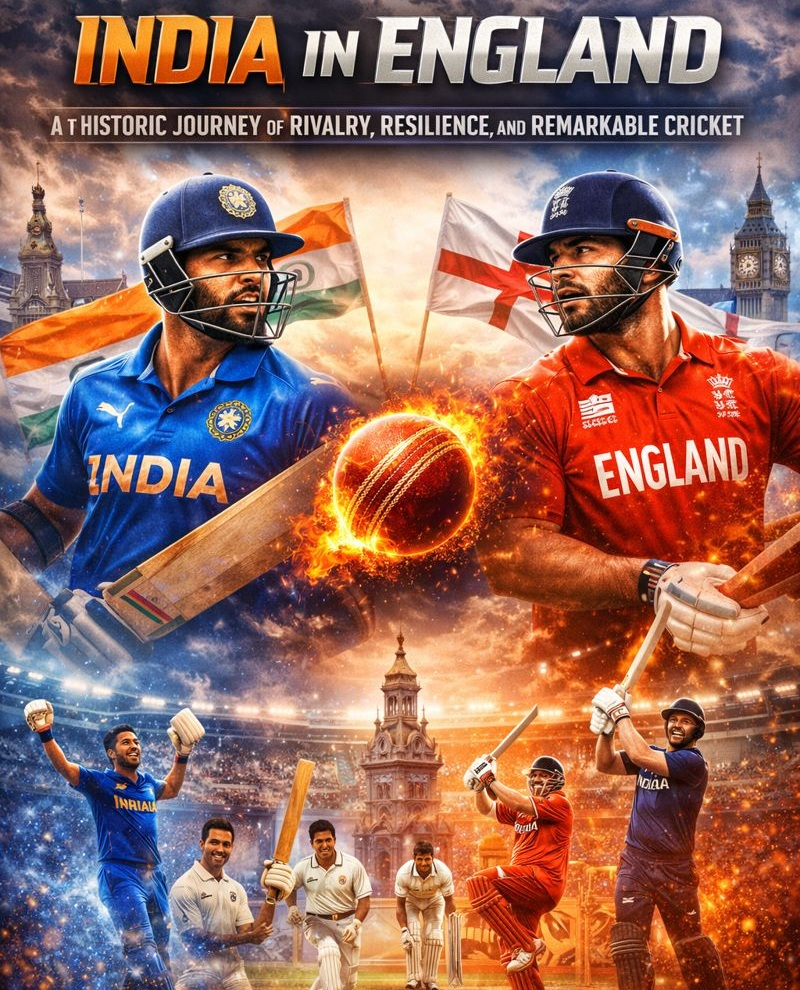
The cricketing rivalry between India and England is one of the oldest, richest, and most fascinating stories in international cricket. When people talk about “India in England”, they refer not just to a series of matches, but to a journey through difficult conditions, legendary performances, heartbreaks, and historic triumphs.
For Indian cricketers, touring England has always been one of the toughest challenges. The swinging ball, overcast skies, green pitches, and relentless English bowling attacks test technique, patience, and mental strength. Over the decades, India’s performances in England have evolved—from early struggles to modern-day competitiveness—reflecting the growth of Indian cricket itself.
Table of Contents
Early Years: India’s First Tours of England
India first toured England in 1932, marking its debut in Test cricket. Led by CK Nayudu, the Indian team faced an experienced English side at Lord’s. Although India lost the match, the tour symbolized the beginning of a long and historic cricketing relationship.
In the early decades, Indian teams found England extremely difficult to conquer. The lack of exposure to seam and swing bowling meant Indian batters struggled, while bowlers often failed to exploit English conditions effectively.
Key Challenges in Early Tours
- Unfamiliar weather and pitch behavior
- Limited preparation and practice matches
- Lack of fast bowling depth
- Psychological pressure of touring England
Despite these challenges, each tour added valuable experience and slowly shaped India’s overseas identity.
1952–1970: Learning Through Struggle
Between the 1950s and 1960s, India toured England multiple times but failed to register a Test series win. However, this era was crucial for learning and adaptation.
Players like Vinoo Mankad, Polly Umrigar, and Subhash Gupte showed flashes of brilliance, while Indian spin bowling occasionally troubled English batters even in seam-friendly conditions.
Although victories were rare, Indian cricket began to understand the importance of technique, fitness, and preparation—lessons that would prove vital in future tours.
1971: The Historic Breakthrough
The 1971 tour of England remains one of the most iconic moments in Indian cricket history. Led by Ajit Wadekar, India achieved its first-ever Test series victory in England, changing the perception of Indian cricket forever.
Key Highlights of 1971 Series
- India won the series 1–0
- Sunil Gavaskar made his presence felt with solid batting
- BS Chandrasekhar produced a magical bowling spell at The Oval
- India chased down a target at The Oval to win the Test
This victory proved that India could compete—and win—in the toughest overseas conditions.
1980s: Mixed Results and Individual Brilliance
The 1980s saw India touring England with mixed results. While series victories remained elusive, Indian players delivered memorable individual performances.
Kapil Dev’s Heroics
Kapil Dev emerged as a key figure during this period. His all-round performances, aggressive batting, and ability to swing the ball in English conditions gave India a fighting edge.
Gavaskar and Amarnath
Indian batting improved significantly, with players like Sunil Gavaskar and Mohinder Amarnath showing strong defensive techniques against swing bowling.
Although England remained dominant at home, India was no longer an easy opponent.
1990: Sachin Tendulkar Announces His Arrival
The 1990 tour of England is unforgettable for one reason—Sachin Tendulkar’s maiden Test century at Old Trafford.
At just 17 years old, Tendulkar scored a magnificent hundred under pressure, saving the Test match for India and announcing his arrival on the world stage.
This innings symbolized a new era for Indian cricket—one driven by skill, confidence, and global ambition.
2002: The Sourav Ganguly Era
The 2002 England tour marked a turning point in India’s overseas mentality. Under Sourav Ganguly’s leadership, India played fearless cricket.
Highlights of the 2002 Tour
- India drew the Test series 1–1
- Memorable performances from Rahul Dravid, Sachin Tendulkar, and Anil Kumble
- Iconic NatWest Trophy final win at Lord’s in ODIs
This tour showed that India could dominate England not just in Tests, but also in limited-overs cricket.
2007: Rahul Dravid Leads India to Glory
India’s 2007 Test series win in England under Rahul Dravid is considered one of the finest achievements in Indian cricket.
Why 2007 Was Special
- India won the series 1–0
- Strong batting from Dravid, Tendulkar, and Laxman
- Effective fast bowling support
- Excellent team discipline and strategy
This series cemented India’s reputation as a competitive overseas Test side.
2011–2014: Setbacks and Lessons
India’s tours of England in 2011 and 2014 were challenging. The team suffered heavy defeats, exposing weaknesses in technique against swing bowling.
However, these setbacks became learning experiences, pushing Indian cricket to invest more in:
- Fast bowling development
- Fitness standards
- Overseas preparation
These lessons laid the foundation for future success.
2018: Kohli’s Warrior Mindset
The 2018 England tour under Virat Kohli marked a dramatic shift in attitude. Although India lost the Test series 4–1, the matches were fiercely competitive.
Virat Kohli’s Historic Performance
Kohli scored 593 runs, the most by an Indian captain in a Test series in England. His determination and adaptability inspired the entire team.
India’s fast bowlers—Jasprit Bumrah, Ishant Sharma, and Mohammed Shami—performed exceptionally well, proving India’s pace attack could dominate in England.
2021–2022: India’s Near-Perfect Campaign
The 2021–22 series showcased India’s maturity as an overseas team. India led the series 2–1 before the final Test, which was played later.
Key Highlights
- Historic win at Lord’s
- Dominant performance at The Oval
- Strong leadership from Kohli and Rohit Sharma
- Balanced team effort
This tour reaffirmed India’s status as one of the world’s best Test teams.
India in England in Limited-Overs Cricket
India’s record in England in ODIs and T20Is has improved significantly over time.
ODIs
- India has won multiple bilateral ODI series in England
- Strong performances from top-order batters
- Spin bowlers have adapted well
T20Is
- Aggressive batting lineups
- Effective use of pace variations
- Increased success in short-format matches
Modern Indian teams are no longer intimidated by English conditions in white-ball cricket.
Iconic Indian Players in England
Legendary Performers
- Sachin Tendulkar – Consistent run-scorer
- Rahul Dravid – The Wall in seaming conditions
- Sunil Gavaskar – Technique and patience
- Virat Kohli – Aggression and dominance
Bowling Heroes
- Kapil Dev
- Anil Kumble
- Jasprit Bumrah
- Ishant Sharma
Each generation has produced heroes who conquered English conditions.
Why England Remains a True Test for India
England continues to be a benchmark for Indian cricket because:
- Conditions constantly challenge technique
- Matches test mental toughness
- Success earns global respect
Winning in England is seen as proof of a team’s greatness.
Future of India in England
With a strong domestic system, advanced training methods, and world-class fast bowlers, India’s future tours of England look promising.
Young players are now better prepared than ever to succeed overseas, making future India-England series even more competitive and exciting.
Conclusion: A Journey of Growth and Glory
The story of India in England is a journey from struggle to strength, from learning to leadership. Each tour has contributed to India’s evolution as a global cricketing powerhouse.
From the historic 1971 victory to modern-day battles, India’s performances in England reflect resilience, adaptability, and an unyielding desire to succeed.