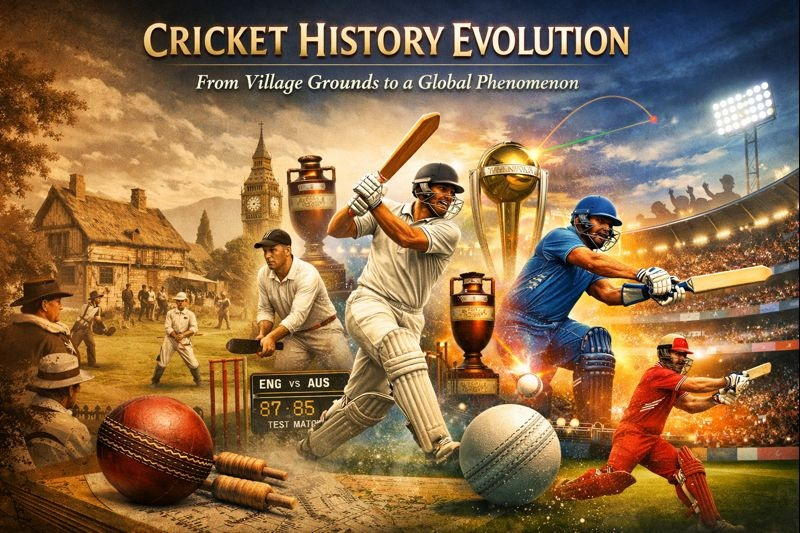

Introduction:Cricket History Evolution
Cricket is one of the world’s oldest and most beloved sports, captivating millions of fans across continents. What began as a simple bat-and-ball game played in rural England has evolved into a multi-billion-dollar global sport featuring iconic tournaments, legendary players, and passionate fan bases. The history and evolution of cricket reflect not only changes in sport but also shifts in culture, technology, politics, and global communication.
Table of Contents
Origins of Cricket (13th–16th Century)
Early Beginnings
The earliest references to cricket date back to the 13th century in southeast England. It is believed that children played a rudimentary form of the game using a curved stick (similar to a shepherd’s crook) to hit a ball made of wool or leather.
The word “cricket” may have originated from:
- The Old English word “cricc” (a stick)
- The Middle Dutch word “krick” (a staff)
By the 16th century, cricket had become a popular recreational activity among adults, especially in agricultural communities.
Cricket in the 17th Century: Growing Popularity
During the 1600s, cricket began to gain recognition as an organized sport. It was frequently played in English villages, often with wagers placed on matches. The sport also attracted the interest of the English nobility, who sponsored teams and players.
Key developments:
- Formation of village and county teams
- Introduction of basic rules
- Cricket becoming a spectator sport
By the end of the century, cricket was firmly established as England’s national pastime.
The 18th Century: Laws and Professionalism
The 18th century marked a turning point in cricket’s evolution.
Codification of Rules
In 1744, the first known Laws of Cricket were written. These rules standardized:
- Pitch length
- Wicket size
- Scoring methods
- Dismissals
Marylebone Cricket Club (MCC)
Founded in 1787, the MCC became cricket’s governing body and custodian of the Laws of Cricket—a role it still holds today.
Rise of Professional Players
Cricket transitioned from a pastime to a profession, with skilled players earning wages and fame.
19th Century: International Cricket Begins
Expansion Through the British Empire
As the British Empire expanded, cricket traveled to:
- India
- Australia
- West Indies
- South Africa
- New Zealand
Cricket became a tool of cultural exchange and colonial influence.
Birth of Test Cricket
- 1877: The first official Test match was played between England and Australia in Melbourne.
- Test cricket became the pinnacle of the sport, emphasizing endurance, skill, and strategy.
The Ashes
The famous Ashes series began in 1882, creating one of the greatest rivalries in sports history.
Early 20th Century: Global Recognition
By the early 1900s, cricket had spread worldwide.
Formation of International Cricket Council (ICC)
- Founded in 1909 as the Imperial Cricket Conference
- Renamed the International Cricket Council (ICC) later
- Became the global governing body of cricket
Growth of National Teams
Countries like India, West Indies, and New Zealand gained Test status, strengthening international competition.
Cricket Formats: Evolution of the Game
Test Cricket
- Oldest and longest format
- Played over five days
- Considered the ultimate test of skill and patience
One Day Internationals (ODIs)
- Introduced in 1971
- Limited to 50 overs per team
- Brought faster pace and wider appeal
T20 Cricket
- Launched in the early 2000s
- 20 overs per side
- Revolutionized cricket with explosive batting and shorter match duration
T20 cricket played a major role in attracting younger audiences and global sponsorship.
Cricket World Cups: A New Era
ICC Cricket World Cup
- First held in 1975
- Became the most prestigious ODI tournament
- Champions include West Indies, India, Australia, Pakistan, Sri Lanka, England
T20 World Cup
- Introduced in 2007
- Increased cricket’s global popularity dramatically
World Cups transformed cricket into a mainstream global sport.
Technological Advancements in Cricket
Technology has played a crucial role in cricket’s evolution:
- Television Broadcasting: Global reach and fan engagement
- Decision Review System (DRS): Improved umpiring accuracy
- Hawk-Eye: Ball tracking technology
- UltraEdge & Snickometer: Enhanced edge detection
- LED stumps and bails: Better visibility
Technology has made cricket fairer, faster, and more entertaining.
Women’s Cricket: Rise and Recognition
Women’s cricket dates back to the 18th century, but gained real momentum in the late 20th century.
Major milestones:
- First Women’s World Cup in 1973
- ICC support and professional leagues
- Equal pay initiatives and global tournaments
Today, women’s cricket enjoys massive viewership and growing respect worldwide.
Franchise Leagues and Commercialization
Indian Premier League (IPL)
- Launched in 2008
- Changed cricket’s financial landscape
- Combined sports, entertainment, and marketing
Other leagues:
- Big Bash League (Australia)
- PSL (Pakistan)
- CPL (Caribbean)
- The Hundred (England)
These leagues increased player earnings and global fan engagement.
Cricket in the Digital Age
Modern cricket thrives on digital platforms:
- Live streaming
- Social media engagement
- Fantasy leagues
- Analytics and data-driven strategies
Fans can now follow matches, players, and stats in real time.
Cricket’s Cultural Impact
Cricket is more than a sport—it’s a cultural phenomenon:
- Unites nations
- Shapes national identity
- Influences fashion, language, and media
In countries like India, Pakistan, Australia, and England, cricket is a way of life.
Challenges and Future of Cricket
Current Challenges
- Balancing traditional and modern formats
- Player workload and injuries
- Maintaining Test cricket’s relevance
Future Prospects
- Expansion into new countries
- Inclusion in global events like the Olympics
- Use of AI and advanced analytics
Cricket continues to evolve while respecting its rich heritage.
Conclusion
The history and evolution of cricket is a remarkable journey spanning centuries. From its humble beginnings in English villages to becoming a global sport loved by billions, cricket has continuously adapted to changing times. Its ability to balance tradition with innovation ensures that cricket will continue to thrive for generations to come.