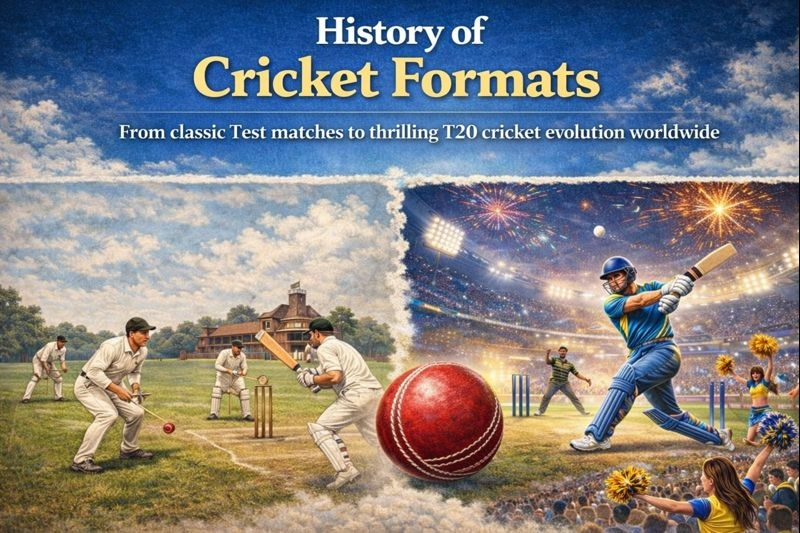

Intriduction:History of Cricket Formats
Cricket is more than just a sport—it is a living tradition that has evolved continuously for over four centuries. From timeless five-day Test matches to fast-paced Twenty20 thrillers, cricket’s formats reflect changing societies, technologies, audiences, and entertainment demands. Each format tells a unique story about how the game adapted while preserving its soul.
Table of Contents
1. The Origins of Cricket: A Game Takes Shape
Cricket’s roots can be traced back to 16th-century England, where it was played by children in rural villages. Early forms of the game involved rudimentary equipment—hand-carved bats and balls made from wool or leather.
By the 17th century, cricket had grown popular among adults and began attracting spectators. The first recorded match dates back to 1646, and by the early 1700s, cricket had become England’s national summer sport.
Key Early Developments
- Introduction of rules and standardized equipment
- Formation of cricket clubs like Hambledon Club
- Growth of gambling, which pushed the need for uniform laws
In 1744, the first known Laws of Cricket were written, laying the foundation for the structured formats that followed.
2. Birth of Test Cricket: The Ultimate Format
The First Test Match (1877)
Test cricket officially began in 1877, when England and Australia played the first recognized Test match at the Melbourne Cricket Ground. This marked the birth of cricket’s most traditional and prestigious format.
Why Is It Called Test Cricket?
The term “Test” reflects the idea that this format tests the skill, patience, technique, and mental strength of players over an extended period.
Characteristics of Test Cricket
- Played over five days
- Each team bats twice
- No over limits
- White clothing and red ball
- Emphasis on technique, strategy, and endurance
3. The Golden Era of Test Cricket
From the late 19th century to the mid-20th century, Test cricket dominated the global cricketing landscape.
Expansion Across the World
- Australia, England, South Africa, and the West Indies became Test nations
- India, Pakistan, and New Zealand joined later
- Cricket spread through British colonial influence
Legendary Test Players
- Sir Don Bradman
- Sunil Gavaskar
- Garfield Sobers
- Imran Khan
- Kapil Dev
These players defined the romance and prestige of Test cricket.
4. Challenges to Test Cricket
By the 1960s, cracks began to appear:
- Long match durations reduced stadium attendance
- Busy lifestyles limited spectators’ time
- Television demanded shorter, more exciting formats
Cricket needed to evolve—or risk losing relevance.
5. The Birth of One Day Cricket
The Accidental Beginning (1971)
One Day Internationals (ODIs) were born unexpectedly. During England’s tour of Australia in 1971, a Test match was abandoned due to rain. To entertain fans, a 40-over per side match was arranged.
The response was overwhelming.
Official Recognition
- ODIs officially introduced in the early 1970s
- First Cricket World Cup held in 1975
6. One Day Internationals: A New Era
ODIs revolutionized cricket by combining strategy with entertainment.
Key Features of ODIs
- Limited overs (initially 60, later 50)
- Colored clothing introduced later
- White ball under floodlights
- Result guaranteed on the same day
Impact on the Game
- Increased scoring rates
- New batting techniques (scoops, reverse sweeps)
- Fielding became more athletic
- Cricket became more TV-friendly
7. The Rise of the Cricket World Cup
The Cricket World Cup became cricket’s most watched global event.
Memorable World Cup Moments
- 1983: India’s historic victory
- 1992: Colored kits and day-night matches
- 1996: Cricket boom in the subcontinent
- 2011: India wins on home soil
- 2019: Dramatic Super Over final
ODIs dominated cricket for nearly three decades.
8. Commercialization and Professionalization
The ODI era introduced:
- Sponsorships
- Broadcast deals
- Player endorsements
- Night matches for prime-time audiences
Cricket transformed from a gentleman’s pastime into a global commercial sport.
9. The Need for Speed: Birth of T20 Cricket
By the early 2000s, attention spans were shrinking, and competition from other sports intensified.
T20’s Origin
- Introduced in England in 2003
- Each team faces 20 overs
- Matches last around 3 hours
The format was designed to attract:
- Younger audiences
- Families
- Casual sports fans
10. T20 Cricket: A Game Changer
T20 cricket completely redefined how the game was played and consumed.
Key Features
- Explosive batting
- Aggressive bowling variations
- High-energy fielding
- Cheerleaders, music, and entertainment
Why T20 Became Popular
- Fast results
- Constant action
- Suitable for television and digital platforms
11. The Rise of Franchise Leagues
Indian Premier League (IPL)
Launched in 2008, the IPL changed cricket forever.
IPL’s Impact:
- Billion-dollar valuations
- Global player participation
- Young talent exposure
- Data-driven strategies
Other major leagues followed:
- Big Bash League (Australia)
- Pakistan Super League
- Caribbean Premier League
- SA20, The Hundred
12. How T20 Changed Player Roles
Traditional roles evolved:
- Power-hitters replaced defensive batsmen
- Bowlers specialized in death overs
- All-rounders became invaluable
- Impact substitutes emerged
Cricket became faster, bolder, and more unpredictable.
13. Technology and Innovation Across Formats
Modern cricket embraced technology:
- Decision Review System (DRS)
- Hawk-Eye and ball tracking
- UltraEdge and Snickometer
- Advanced fitness tracking
Each format benefited differently, improving fairness and viewer experience.
14. The Hundred and New Experiments
In search of innovation, cricket boards introduced experimental formats like The Hundred, featuring:
- 100 balls per innings
- Simplified rules
- Fast-paced gameplay
These formats aim to attract new audiences while keeping cricket accessible.
15. Test Cricket in the Modern Era
Despite shorter formats, Test cricket remains relevant.
Why Test Cricket Still Matters
- Purest form of the game
- Ultimate skill test
- Rich traditions and rivalries
- World Test Championship revived interest
Iconic Test matches still capture global attention.
16. Balancing Tradition and Entertainment
Modern cricket walks a fine line:
- Preserving Test cricket’s legacy
- Embracing T20’s commercial success
- Managing player workload
- Maintaining competitive balance
Scheduling and prioritization remain ongoing challenges.
17. The Role of Women’s Cricket
Women’s cricket has grown across all formats:
- Women’s World Cups
- Women’s T20 leagues
- Increased media coverage
- Professional contracts
Women’s T20 cricket, in particular, has accelerated global growth.
18. Fan Experience Through the Ages
Cricket fandom evolved from:
- Radio commentary
- Black-and-white television
- Live stadium experiences
- Streaming, social media, and fantasy leagues
Each format caters to different fan expectations.
19. The Future of Cricket Formats
The future promises:
- Shorter, sharper formats
- More franchise leagues
- Enhanced technology
- Sustainable scheduling models
However, preserving cricket’s soul remains crucial.
20. Conclusion: One Game, Many Stories
From the timeless battles of Test cricket to the adrenaline-charged excitement of T20 matches, cricket’s formats tell a story of evolution, resilience, and innovation.
Each format has its place:
- Test cricket celebrates patience and mastery
- ODIs balance strategy and excitement
- T20s deliver instant entertainment